
Buying a few bags of ice is easy when you are planning an occasional party. But when you purchase ice every week—or every day—the cost, freezer space, store trips, and risk of running out can quickly become frustrating.
A commercial ice maker takes a different approach. It requires a larger upfront investment and may need a water line, drain, electrical outlet, and regular cleaning. Once installed, however, it can produce a steady supply of ice throughout the day.
So, is it cheaper to continue buying bagged ice or invest in a commercial ice maker?
For occasional use, bagged ice is usually the more economical option. For frequent home entertaining, office drink stations, cafés, and other spaces with consistent ice demand, a commercial ice maker may provide better long-term value and convenience.
The right answer depends on:
-
How much ice you use
-
How often you buy bagged ice
-
The price of ice in your area
-
Your available installation space
-
Local electricity and water rates
-
Cleaning and maintenance costs
-
How much you value convenience
This guide explains how to compare the real cost of both options.
Bagged Ice vs. Commercial Ice Maker: Quick Comparison
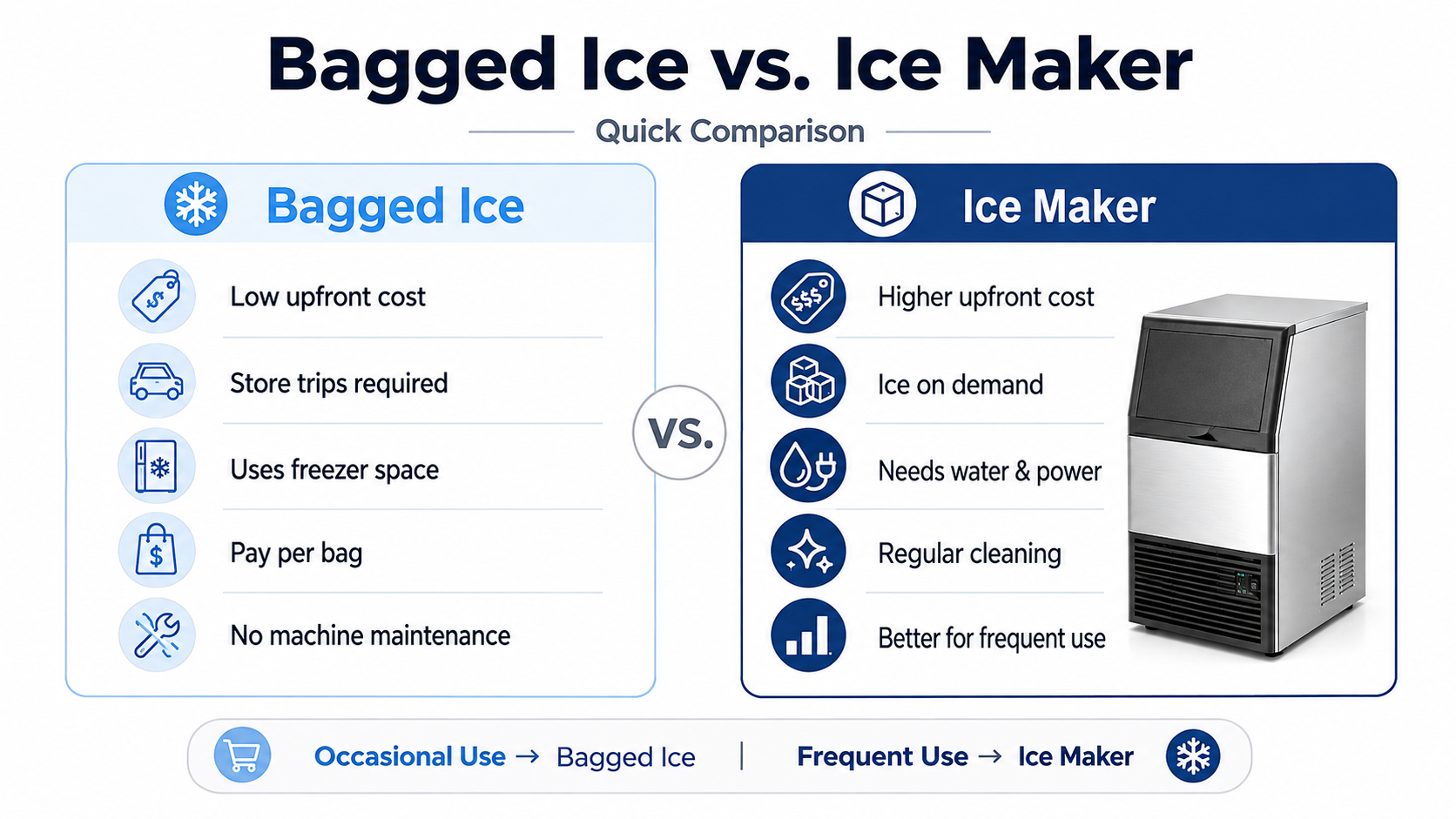
| Factor | Bagged Ice | Commercial Ice Maker |
|---|---|---|
| Upfront cost | Low | Higher |
| Installation | None | Water, drain, power, and ventilation may be required |
| Ongoing cost | Cost of every bag | Electricity, water, filters, and cleaning |
| Ice availability | Requires advance purchases | Produces ice throughout the day |
| Storage | Requires freezer or cooler space | Uses a built-in insulated storage bin |
| Maintenance | Minimal | Requires routine cleaning and descaling |
| Ice consistency | May vary by supplier | Consistent ice type and adjustable thickness on some models |
| Best for | Occasional or seasonal use | Frequent or daily ice use |
| Large one-time events | Easy to purchase additional bags | Limited by production and storage capacity |
| Convenience | Requires transportation and planning | Ice is available at the installation location |
The basic decision is straightforward:
Choose bagged ice if you only need extra ice several times per year.
Consider a commercial ice maker if you purchase ice regularly, frequently entertain guests, or need ice as part of daily beverage service.
How Much Are You Spending on Bagged Ice?
Before comparing products, calculate what you currently spend on ice.
The price of bagged ice varies by retailer, location, bag size, and season. Instead of using a national average, check your recent receipts or the current price at the store where you usually shop.
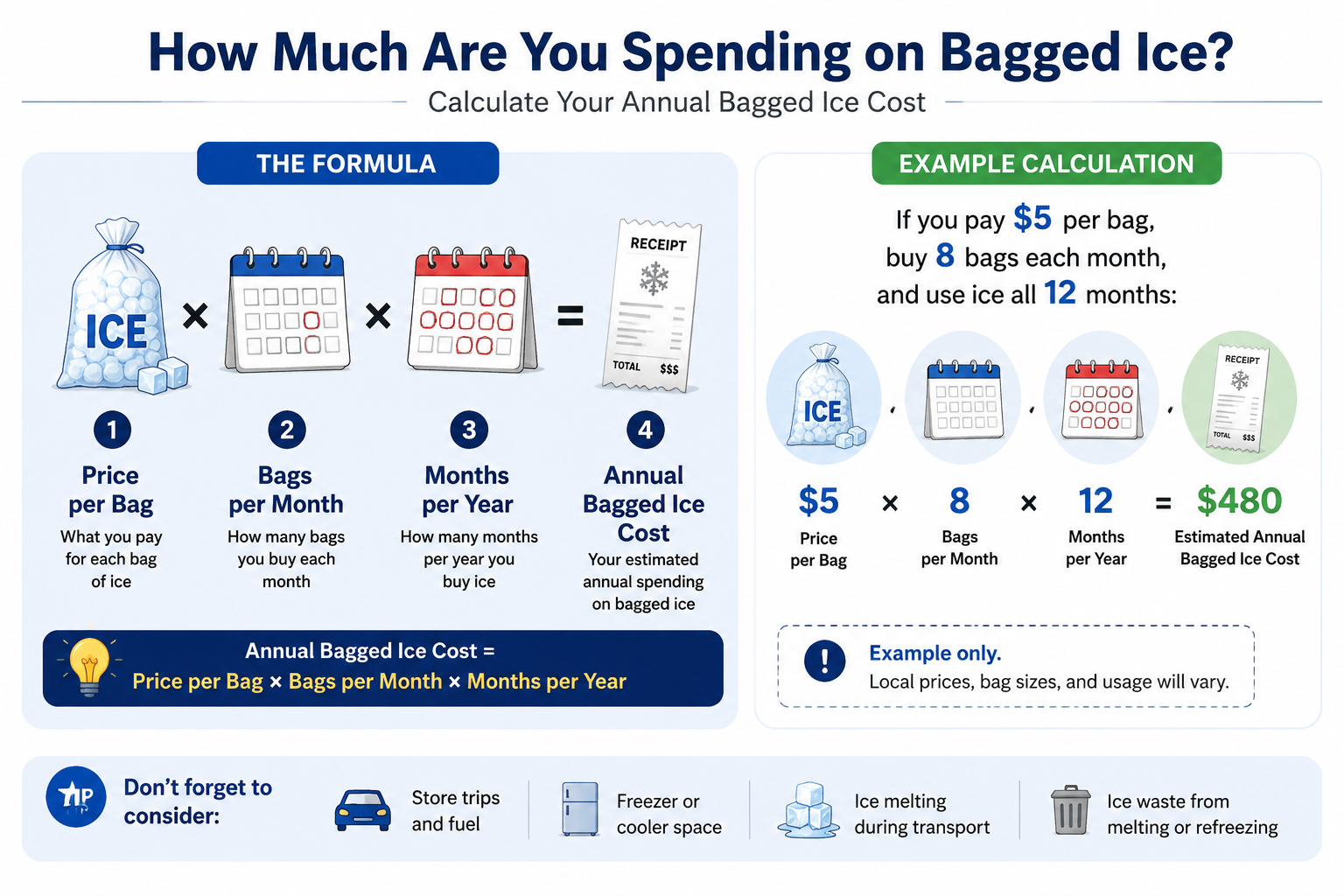
Use this formula:
Annual bagged ice cost = Price per bag × Bags purchased per month × Months used per year
For example, suppose a bag costs $5 and you purchase eight bags per month:
$5 × 8 × 12 = $480 per year
Here are three hypothetical examples:
| Usage pattern | Bags per month | Example price per bag | Estimated annual cost |
|---|---|---|---|
| Occasional entertaining | 2 | $5 | $120 |
| Frequent home bar use | 8 | $5 | $480 |
| Regular office or café use | 20 | $5 | $1,200 |
These figures are examples only. Use your actual local price and purchase frequency for a more accurate comparison.
Compare the Cost per Pound
Bag sizes can vary, so comparing only the price per bag may be misleading.
Calculate the cost per pound with this formula:
Cost per pound = Price per bag ÷ Weight of the bag
For example:
$5 ÷ 10 lb = $0.50 per pound
If another retailer sells a 20-pound bag for $8:
$8 ÷ 20 lb = $0.40 per pound
The larger bag costs more at checkout but provides a lower cost per pound.
When reviewing your ice expenses, record:
-
The price of each bag
-
The weight of each bag
-
How many bags you buy
-
How frequently you buy them
-
How much ice melts or goes unused
The Hidden Costs of Buying Bagged Ice
The store price is only part of the cost. Regular bagged-ice purchases also require time, transportation, storage, and planning.
Store Trips
Every bag must be purchased and transported.
For an occasional party, adding ice to a grocery order may not be a problem. For frequent users, however, repeated ice runs can become inconvenient.
You may need to:
-
Plan purchases before an event
-
Drive to a store
-
Wait in line
-
Carry heavy bags
-
Return for more if demand is higher than expected
A business may also need to assign an employee to purchase ice during operating hours. The employee’s time and the interruption to service are part of the real cost.
Freezer Space
Bagged ice requires frozen storage.
Several bags can occupy a large portion of a household freezer, leaving less room for food. A home bar or party space may also require a separate freezer or multiple coolers.
For a café, office, or small business, storing bagged ice may require:
-
A dedicated freezer
-
Additional floor space
-
Higher electricity use
-
Regular freezer organization
-
Space for empty or partially used bags
A commercial ice maker also requires space, but it produces and stores ice in one dedicated location.
Transportation and Melting
Ice can begin melting as soon as it leaves the store.
The amount lost depends on:
-
Outdoor temperature
-
Travel time
-
Vehicle temperature
-
Packaging condition
-
How quickly the ice reaches a freezer
Partially melted ice may freeze together into a solid block. It can become difficult to scoop and may need to be broken apart before use.
Running Out During Busy Periods
Running out of ice during a quiet evening is inconvenient. Running out during a party, meeting, or busy café shift can be disruptive.
For home users, someone may need to leave the event to buy additional bags.
For a business, running out may mean:
-
Delayed drink orders
-
Reduced menu availability
-
Interrupted employee workflow
-
Unexpected emergency purchases
-
An inconsistent customer experience
A commercial ice maker does not provide unlimited ice, but it can continue producing replacement ice throughout the day.
What Does It Cost to Own a Commercial Ice Maker?
A realistic comparison should include more than the purchase price.
Commercial ice maker ownership can involve seven main expenses:

-
Machine price
-
Installation
-
Electricity
-
Water
-
Water filtration
-
Cleaning and maintenance
-
Repairs and downtime
1. Purchase Price
The purchase price varies based on:
-
Daily production capacity
-
Storage-bin size
-
Ice shape
-
Machine dimensions
-
Construction materials
-
Built-in or freestanding design
-
Controls and cleaning features
-
Warranty coverage
The least expensive machine is not automatically the most economical choice.
A machine that is too small may not produce enough ice during busy periods. A machine that is unnecessarily large may cost more, occupy additional space, and exceed your actual needs.
The most practical option is usually one that can handle normal daily demand while providing enough additional capacity for busier periods.
2. Installation Cost
Many undercounter commercial ice makers require:
-
A cold water supply
-
A drain connection
-
A grounded electrical outlet
-
Adequate ventilation
-
Sufficient service clearance
Installation may be relatively simple when these utilities are already available.
Additional work may be necessary if the installation space does not have a nearby water line or suitable drain. Built-in installations may also require cabinet modifications.
Possible installation expenses include:
-
Water supply fittings
-
Inlet tubing
-
Drain tubing
-
Shutoff valve
-
Water filter
-
Drain accessories
-
Plumbing labor
-
Electrical work
-
Cabinet modifications
Before ordering an ice maker, inspect the complete installation area. Do not compare only the width of the machine with the cabinet opening. Leave room for hoses, connections, ventilation, and future service access.
For more preparation advice, read our [Undercounter Ice Maker Installation Checklist].
3. Electricity Cost
A commercial ice maker uses electricity during ice production, harvesting, controls, and other operating stages.
However, rated wattage does not necessarily mean the machine consumes that amount of power every minute of the day. Actual energy use can change as the compressor and other components cycle on and off.
Electricity consumption may be affected by:
-
Daily ice demand
-
Room temperature
-
Incoming water temperature
-
Selected ice thickness
-
Ventilation
-
Mineral buildup
-
Cleaning condition
-
How often the storage bin becomes full
When measured energy consumption is available, use this formula:
Electricity cost = Kilowatt-hours used × Local electricity rate
For example, if a machine uses 30 kWh in one month and your electricity rate is $0.18 per kWh:
30 × $0.18 = $5.40 per month
This is only a calculation example. It is not an estimated monthly cost for a specific model.
Use your own utility rate and measured or manufacturer-provided energy consumption for a more accurate estimate.
4. Water Cost
A commercial ice maker needs water to produce ice. Water may also be used during cleaning and flushing cycles.
The actual water cost depends on:
-
How much ice the machine produces
-
How frequently it operates
-
Machine design
-
Cleaning frequency
-
Local water and sewer rates
-
Water pressure and temperature
-
Mineral buildup
-
Meltwater and drainage
A machine rated for up to 100 pounds of ice per day will not necessarily produce 100 pounds every day. If the storage bin is full or demand is low, the machine may pause production.
Do not calculate water costs by assuming the machine operates at maximum output continuously unless that reflects your actual usage.
5. Water Filtration
Water quality can affect ice taste, clarity, machine performance, and mineral buildup.
Depending on local conditions, an installation may use:
-
A sediment filter
-
An activated-carbon filter
-
A scale-control filter
-
A multi-stage filtration system
Filtration expenses may include:
-
Filter housing
-
Replacement cartridges
-
Tubing and fittings
-
Installation labor
Filter replacement frequency depends on water quality, water use, filter capacity, and manufacturer recommendations.
A filter can help manage certain water-quality issues, but it does not eliminate the need for regular cleaning and descaling.
6. Cleaning and Maintenance
Commercial ice makers require routine maintenance.
Typical tasks may include:
-
Running the self-cleaning cycle
-
Cleaning the storage bin
-
Sanitizing food-contact surfaces
-
Removing mineral scale
-
Inspecting the water inlet hose
-
Inspecting the drain hose
-
Checking for leaks
-
Cleaning ventilation openings
-
Replacing water filters
Cleaning frequency depends on how often the machine is used, the surrounding environment, and local water quality.
A machine in a hard-water area may need more frequent descaling. A machine in a busy café may require more frequent cleaning than one used occasionally in a home bar.
Maintenance expenses can include:
-
Ice machine cleaner
-
Sanitizer
-
Descaling solution
-
Replacement filters
-
Cleaning tools
-
Professional service when necessary
Ignoring maintenance may reduce ice quality, slow production, and contribute to avoidable operating problems.
See our complete guide on [How to Clean and Maintain an Undercounter Ice Maker] for recommended cleaning steps.
7. Repairs and Downtime
Like other appliances, an ice maker may eventually need service.
Possible service areas include:
-
Water inlet components
-
Drain components
-
Pumps
-
Sensors
-
Fans
-
Control boards
-
Refrigeration components
-
Compressor
Before buying, review:
-
Full-machine warranty duration
-
Compressor warranty duration
-
Parts coverage
-
Labor coverage
-
Shipping responsibilities
-
Technical-support availability
-
Replacement-parts availability
Businesses should also consider the cost of downtime. If the machine is unavailable, bagged ice may still be required until service is completed.
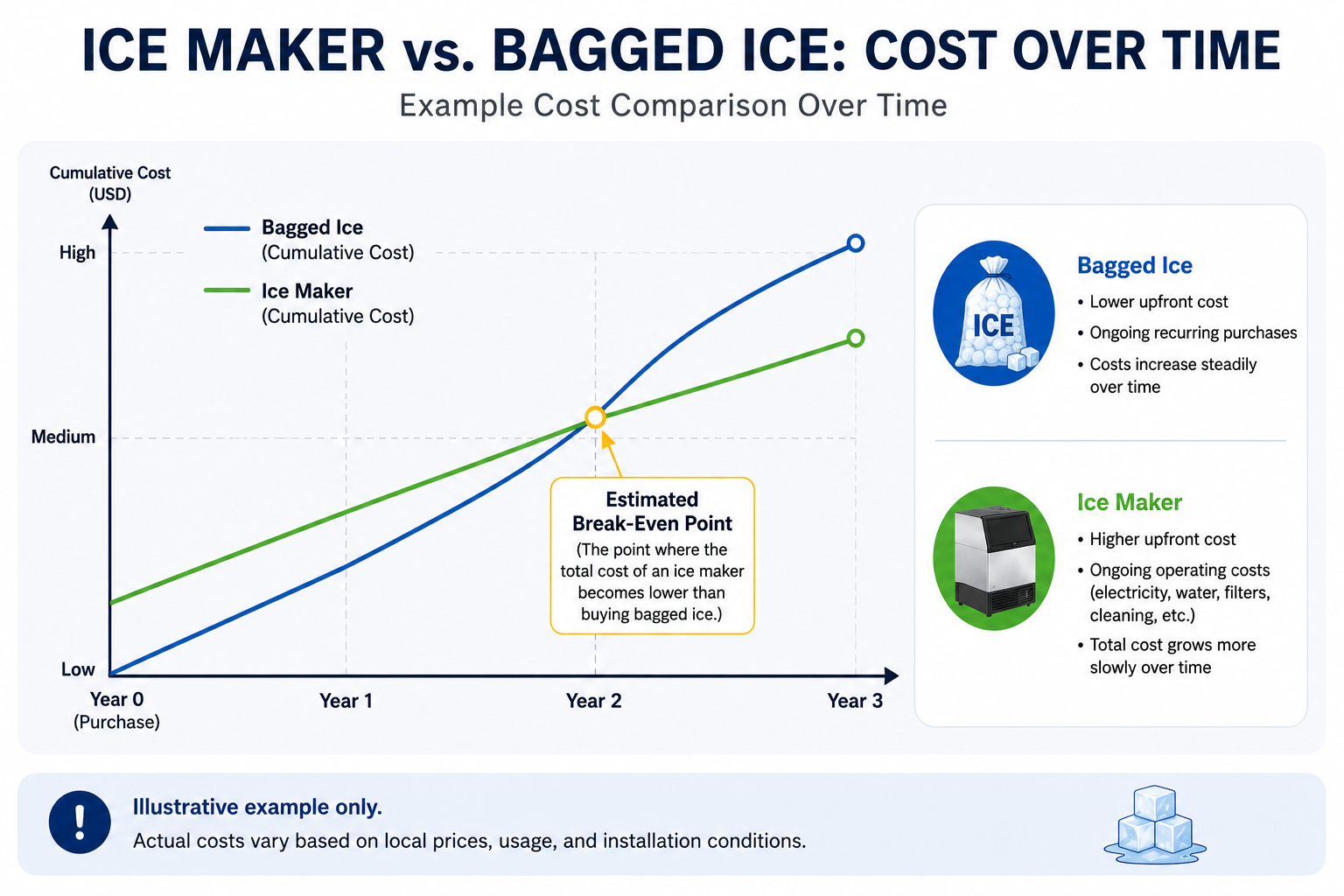
How to Calculate Your Break-Even Point
A break-even calculation estimates when the cost of owning an ice maker may become comparable to the cost of continuing to purchase bagged ice.
It should not be treated as a guaranteed savings figure. Actual results depend on usage, utility rates, installation, maintenance, repairs, and the useful life of the machine.
Step 1: Calculate Your Annual Bagged-Ice Cost
Use:
Bag price × Bags purchased per month × Months used per year
Example:
$5 × 10 bags × 12 months = $600 per year
Step 2: Calculate the Initial Ice Maker Cost
Add:
Machine price + Installation + Initial filtration equipment + Required accessories
Hypothetical example:
| Initial expense | Example cost |
|---|---|
| Ice maker | $400 |
| Installation | $150 |
| Filter and fittings | $50 |
| Total initial cost | $600 |
These figures are examples and do not represent a specific installation.
Step 3: Calculate Annual Operating Costs
Add:
Electricity + Water + Filters + Cleaning supplies + Routine maintenance
Hypothetical example:
| Annual expense | Example cost |
|---|---|
| Electricity | $75 |
| Water | $20 |
| Filters | $40 |
| Cleaning supplies | $25 |
| Total annual operating cost | $160 |
Step 4: Estimate Annual Cost Avoided
If you currently spend $600 per year on bagged ice and estimate $160 in annual operating expenses:
$600 − $160 = $440 in annual cost avoided
Step 5: Estimate the Break-Even Period
Use:
Initial machine and installation cost ÷ Annual bagged-ice cost avoided
Using the hypothetical figures above:
$600 ÷ $440 = approximately 1.36 years
This calculation is only an example.
It does not include unexpected repairs, financing costs, changes in bagged-ice prices, changes in utility rates, or changes in your ice consumption.
A Simple Cost Worksheet
Use the following worksheet with your own numbers.
Current Bagged-Ice Cost
| Question | Your answer |
|---|---|
| Price per bag | $_____ |
| Pounds per bag | _____ lb |
| Bags purchased per month | _____ |
| Months used per year | _____ |
| Estimated annual bagged-ice cost | $_____ |
Estimated Ice Maker Cost
| Expense | Your estimate |
|---|---|
| Machine | $_____ |
| Installation | $_____ |
| Water filter and fittings | $_____ |
| Annual electricity | $_____ |
| Annual water | $_____ |
| Annual filters | $_____ |
| Annual cleaning and maintenance | $_____ |
Once you have these figures, compare the first-year cost and the estimated three-year cost of both options.
Three Common Buyer Scenarios
The following examples show why the answer can be different for each buyer.
Scenario 1: Occasional Party Host
This household:
-
Hosts four to six events per year
-
Rarely needs extra ice between events
-
Purchases several bags before each party
-
Does not have an existing water line or drain near the bar area
-
Has enough freezer or cooler space
In this situation, bagged ice will often remain the more economical choice.
The household avoids:
-
The machine purchase
-
Plumbing work
-
Permanent floor-space requirements
-
Cleaning and maintenance
-
Electricity and water costs
A commercial ice maker may provide additional convenience, but the low annual usage may not justify the cost based on savings alone.
Scenario 2: Frequent Home Entertainer
This household:
-
Makes cocktails or iced drinks several times per week
-
Hosts guests at least once a month
-
Regularly purchases bagged ice
-
Has a dedicated home bar or entertainment room
-
Has access to a water line and drain
-
Wants to free up freezer space
A commercial ice maker may make more sense in this situation.
The financial benefit depends on the household’s actual bagged-ice expenses, but convenience may be equally valuable.
Instead of purchasing and storing ice before every gathering, the household can produce ice near the bar throughout the day.
Scenario 3: Small Café, Office, or Shared Drink Station
This location:
-
Uses ice every day
-
Serves iced coffee, tea, soda, or other cold drinks
-
Purchases multiple bags each week
-
Uses employee time to buy and transport ice
-
Needs predictable availability
-
Has limited freezer space
Consistent demand may make an ice maker easier to justify.
However, a business should evaluate both daily demand and peak demand.
A machine may produce enough ice over 24 hours but still fall behind if most of the ice is needed during a two-hour lunch or afternoon rush.
Consider:
-
Ice required per drink
-
Number of drinks during the busiest hour
-
Starting storage-bin level
-
Recovery time
-
Seasonal demand
-
Ice used for coolers or food service
When Bagged Ice Is the Better Choice
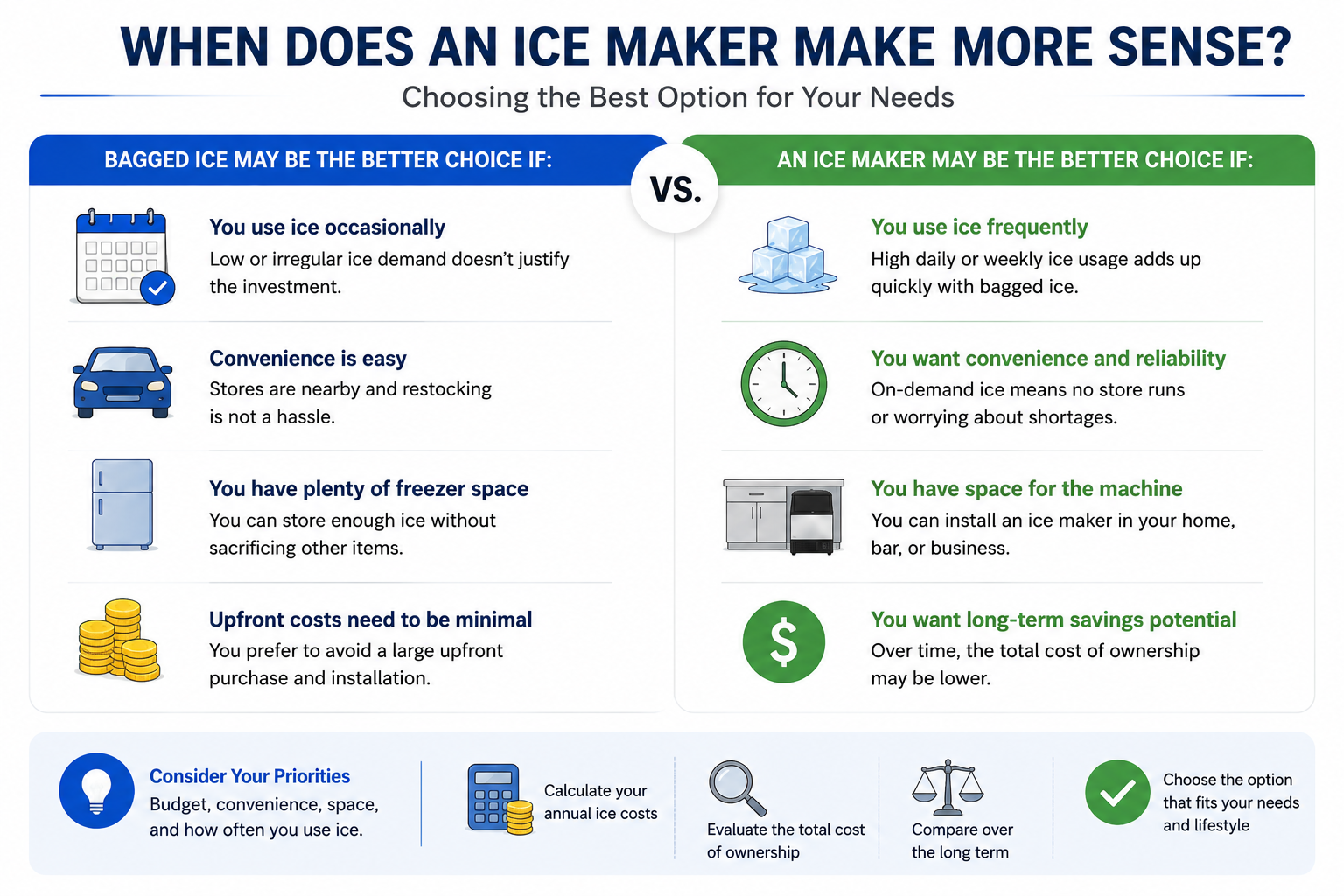
Bagged ice may be the better option when:
-
You only need extra ice several times per year
-
Most of your demand is seasonal
-
You rent and cannot change the plumbing
-
There is no suitable drain
-
You do not have permanent space for a machine
-
You need a large amount for one isolated event
-
You do not want another appliance to maintain
-
Your annual bagged-ice spending is low
-
You already have sufficient freezer space
Bagged ice offers flexibility. You can buy more or less for each event without committing to a machine.
When a Commercial Ice Maker Makes More Sense
A commercial ice maker may be a better fit when:
-
You buy bagged ice every week
-
You use ice almost every day
-
You regularly entertain guests
-
You have a dedicated home bar
-
You operate a café or beverage station
-
Your office refrigerator cannot meet demand
-
Bagged ice occupies too much freezer space
-
Emergency store trips interrupt your routine
-
You want a consistent cube style
-
Your location already has suitable utilities
The value is usually easier to justify when ice use is frequent, predictable, and ongoing.
Cost Is Not the Only Difference
The lowest-cost option is not always the most practical option.
Consider the following differences before making a decision.
Availability
Bagged ice must be purchased in advance.
A commercial ice maker can produce replacement ice throughout the day, provided that it has water, power, drainage, and adequate operating conditions.
Convenience
A dedicated machine reduces repeated shopping, transportation, and freezer management.
However, it also requires cleaning and maintenance.
Ice Consistency
Bagged ice can vary in shape, size, clarity, and condition.
A commercial ice maker produces a consistent ice type. Some machines also allow the user to adjust ice thickness for different beverages.
Capacity
Bagged ice can be purchased in additional quantities whenever necessary, assuming it is available and you have enough freezer or cooler space.
A commercial machine is limited by:
-
Daily production
-
Production speed
-
Storage capacity
-
Environmental conditions
-
Peak-hour demand
Always compare production capacity and storage capacity separately.
Space
Bagged ice occupies freezer or cooler space.
An undercounter machine requires permanent installation space, utility connections, ventilation, and service access.
Maintenance
Bagged ice requires little maintenance beyond frozen storage.
A commercial machine requires regular cleaning, descaling, filter changes, and inspection.
Is a 100 lb/Day Ice Maker the Right Size?
A 100 lb/day undercounter ice maker can be a practical middle-ground option for people who need more capacity than a small countertop machine but do not need a large restaurant-scale system.
It may suit:
-
Dedicated home bars
-
Frequent home entertainers
-
Small cafés
-
Coffee stations
-
Office break rooms
-
Game rooms
-
Party rooms
-
Light commercial beverage service
A 100 lb/day rating refers to how much ice the machine can produce over a 24-hour period under specified conditions. It does not mean that the machine stores 100 pounds at one time.
Storage-bin capacity should be considered separately.
For help estimating the correct capacity, read What Size Ice Maker Do I Need for a Home Bar?.
A Closer Look at the Mojgar 100 lb/Day Ice Maker
The Mojgar 100 lb/day Undercounter Commercial Ice Maker is designed for homes, entertainment spaces, offices, cafés, and light commercial use.
Its current listed specifications include:
-
Up to 100 lb of ice production per day
-
33 lb insulated ice storage
-
Clear cube ice
-
Adjustable ice thickness
-
First batch in as little as eight minutes under suitable conditions
-
Built-in or freestanding placement
-
One-touch self-cleaning
-
Stainless steel construction
-
AC 110V / 60Hz operation
-
Rated power of 264W ±10%
-
Listed noise level of no more than 50 dB
-
Dimensions of 16.43 × 15.22 × 29.76 inches
-
12-month full-machine warranty
-
36-month compressor warranty
The machine requires a cold water supply, a proper drain connection, a grounded electrical outlet, and adequate ventilation.
Its 33 lb storage bin is insulated but not refrigerated. Some ice melting is normal, and meltwater must drain properly.
The Mojgar model may be a practical fit when you:
-
Need ice regularly
-
Have an appropriate installation location
-
Want more output than a countertop unit
-
Prefer clear cube ice
-
Need ice for both everyday drinks and gatherings
-
Want to reduce repeated bagged-ice purchases
It may not be the best choice when you:
-
Only need ice occasionally
-
Cannot connect a water line
-
Do not have a suitable drain
-
Cannot provide adequate ventilation
-
Need all 100 pounds of ice available at one time
-
Do not want to perform routine cleaning
Questions to Ask Before Buying
Use this checklist before choosing between bagged ice and an ice maker.
Ice Demand
-
How many bags did you purchase during the past three months?
-
How many pounds were in each bag?
-
Is your demand consistent or seasonal?
-
How much ice do you need during your busiest hour?
-
Will the ice be used only in drinks?
-
Do you also need ice for coolers, bottles, or food service?
Current Spending
-
What is your average price per bag?
-
How much do you spend each month?
-
Do you make special trips to buy ice?
-
Do you use a separate freezer?
-
How much ice melts or goes unused?
Installation
-
Is there a cold water supply nearby?
-
Is a suitable drain available?
-
Is there a grounded electrical outlet?
-
Is the space properly ventilated?
-
Is there enough room for hoses and service access?
-
Will plumbing or cabinet work be necessary?
Ownership
-
Are you willing to clean the machine regularly?
-
Does your area have hard water?
-
Will you need a filtration system?
-
What does the warranty cover?
-
Who is responsible for labor or shipping?
-
What will you do if the machine is temporarily unavailable?
Final Verdict
Bagged ice offers a low upfront cost, no installation, and flexibility. It is usually the better choice for occasional parties, seasonal activities, and locations without permanent plumbing.
A commercial ice maker requires more planning. Buyers must account for the machine, installation, electricity, water, filtration, cleaning, and possible maintenance.
For frequent users, however, an ice maker can reduce repeated store trips, free up freezer space, and provide a more consistent supply of ice.
The best decision begins with your real numbers.
Review three to six months of ice purchases. Calculate how much you spend per year. Then compare that amount with the estimated purchase, installation, and operating costs of a properly sized machine.
For occasional use, bagged ice will often cost less.
For regular home entertaining, office use, or daily beverage service, making ice on-site may offer stronger long-term value and convenience.
Frequently Asked Questions
Is a commercial ice maker cheaper than buying bags of ice?
It can be, but only when you use enough ice. Occasional users will usually spend less by purchasing bagged ice. Frequent users should compare annual bagged-ice spending with the machine’s purchase, installation, electricity, water, filtration, and maintenance costs.
How often do I need to buy ice before an ice maker is worth it?
There is no universal purchase frequency. Review your bagged-ice spending from the past three to six months and calculate an annual total. The more frequently you purchase ice, the easier it may be to justify a dedicated machine.
How do I calculate the cost per pound of bagged ice?
Divide the bag price by the weight of the bag:
Cost per pound = Price per bag ÷ Pounds per bag
This calculation makes it easier to compare different bag sizes and retailers.
How much electricity does a commercial ice maker use?
Electricity consumption varies by model, daily demand, operating cycle, room temperature, incoming water temperature, selected ice thickness, ventilation, and maintenance condition. Use measured kilowatt-hours and your local electricity rate for the most accurate estimate.
Does a commercial ice maker require plumbing?
Most automatic undercounter ice makers require a cold water supply and a drain. Requirements vary by model, so check the installation instructions before purchasing.
The Mojgar 100 lb/day model requires a cold water line, proper drainage, AC 110V/60Hz power, and adequate ventilation.
Is bagged ice better for occasional parties?
Usually, yes. Bagged ice allows occasional hosts to purchase only what they need without paying for a machine, plumbing, electricity, cleaning, or maintenance.
Can a 100 lb/day ice maker store 100 pounds of ice?
Not necessarily. Daily production and storage capacity are different.
The Mojgar 100 lb/day model is rated to produce up to 100 lb over 24 hours under specified conditions, while its insulated bin stores up to 33 lb at one time.
Does an ice maker storage bin keep ice permanently frozen?
Many commercial ice storage bins are insulated rather than refrigerated.
The Mojgar model’s bin is insulated but is not a freezer. Some melting is normal, and meltwater must drain through a proper drain connection.
Can an ice maker replace bagged ice for a large party?
It depends on the production rate, storage capacity, starting ice level, number of guests, and peak demand.
For a large event, users can produce ice in advance and transfer it to a suitable freezer-safe container. Additional bagged ice may still be useful when the event requires more ice than the machine can produce and store.
What size ice maker is best for a home bar?
The correct size depends on how many drinks you serve, how frequently you entertain, available installation space, storage capacity, and peak demand.
Occasional users may only need a countertop machine. Frequent entertainers and dedicated home bars may benefit from an undercounter model with higher daily production.
What expenses should I include when comparing the two options?
Include:
-
Machine purchase price
-
Plumbing and installation
-
Electricity
-
Water
-
Filtration
-
Cleaning products
-
Routine maintenance
-
Potential repairs
-
Backup ice during downtime
Ready to Make Ice On-Site?
If you use ice regularly and have access to a cold water supply, drain, grounded outlet, and suitable installation space, the Mojgar 100 lb/day Undercounter Commercial Ice Maker may provide a practical alternative to repeated bagged-ice purchases.
Review the dimensions, production capacity, storage capacity, installation requirements, and warranty before ordering.
Explore the Mojgar 100 lb/day Undercounter Commercial Ice Maker